Nearly half of HR professionals say burnout is their biggest concern going into 2026. Not talent shortages. Not compliance. Burnout.
And if you’re reading this while managing a full inbox, a stack of leave requests, and a performance cycle that never seems to end, that number probably feels low.
The good news is that implementing proactive strategies for managing HR exhaustion makes this a fixable problem. The right hr burnout prevention tools can take the weight off your team before it becomes a crisis, no meditation app required.
This guide breaks down what’s actually causing HR burnout, the tools that address it, and how to build a system that makes recovery part of the job, not a reward for surviving it.
The “Hidden” Admin Tax Is Why Your HR Team Is Running on Empty
HR burnout is not a willpower problem.
It’s a workload design problem. Studies show HR professionals spend close to 40% of their time on repetitive manual tasks, payroll, compliance paperwork, leave approvals, and performance tracking.
That’s nearly half the workday gone before any real people strategy work begins.
This is what’s called the hidden admin tax. Every disconnected tool adds to that tax, highlighting the common hurdles in syncing personnel and salary data across fragmented systems. HR becomes the human glue between broken processes instead of the strategic force it’s supposed to be.
When you combine rising compliance demands with the limited resources of scalable digital tools for growing teams, the result is chronic stress and exhaustion.
The exact symptoms that define burnout. And here’s the cruel irony: burned-out HR teams can’t design effective programs to prevent burnout for the rest of the business. The problem feeds itself.
Fixing this starts with treating burnout as a process failure. Not a personal one.
Pro Tip: Before investing in any new tool, audit where your HR team’s hours actually go each week. You’ll likely find nearly half their time is spent on tasks that disappear when moving from paper-based workflows to automated systems.
4 Software-Backed Strategies That Actually Give HR Teams Their Time Back
Wellness programs have value. But they don’t fix overloaded inboxes. The HR teams that are winning in 2026 are pairing behavioral support with real workload reduction.
Here’s what that looks like in practice.
Automate the repetitive work
By utilizing a unified administration and compensation platform, teams can cut time spent on payroll and compliance by up to 50%.
When forms, approvals, and notifications run through a unified HR platform, your team stops chasing paperwork and starts doing real work. Fewer manual tickets mean less mental clutter and more capacity for culture-building and retention.
TaskFino’s HRMS module simplifies integrating new hires in a virtual environment alongside attendance and leave tracking. so your team isn’t switching between five tools to answer one question.
Use AI to spot workload problems before they become people problems
Several platforms now offer AI-driven analytics that pull data from calendars, time tracking, and collaboration tools.
These dashboards flag employees or teams who are consistently working late, skipping breaks, or carrying disproportionate task loads. HR can then redistribute work, delay non-urgent projects, or initiate workload conversations at the manager level.
Heads Up: These tools generate early warning signals , not diagnoses. Use these insights as a guide for overseeing distributed workforces effectively and starting supportive conversations.
Run pulse surveys that actually catch problems early
Burnout doesn’t announce itself.
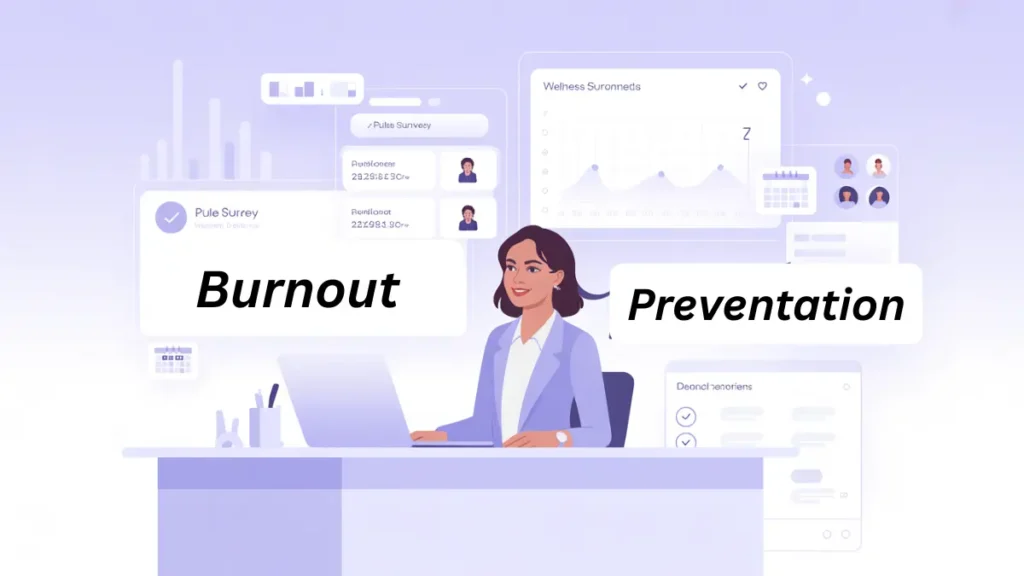
It builds quietly until someone quits or breaks down. Modern HR platforms embed short, frequent pulse surveys directly into HR portals or communication tools. Natural-language processing then scans open-text responses for signs of rising cynicism or disengagement.
This is one of the most effective ways to tackle modern obstacles in people operations before they lead to high turnover.
Connect well-being support inside the HR platform
Leading platforms now integrate counseling access, stress-management courses, coaching, and micro-learning modules directly into the HR experience.
Employees get support without having to hunt for it. And HR isn’t just pointing people toward a helpline, they’re facilitating recovery as part of how work is designed.

The HR Burnout Prevention Toolkit: What You Actually Need in 2026
Not every HR tool is built for resilience. Here are the core features that belong in a serious hr burnout prevention tools stack.
Smart workflow and case management
Case management tools standardize how HR handles grievances, policy questions, and incidents.
Utilizing centralized storage for employee records, combined with routing rules ensures HR isn’t trapped in endless email chains. Less ad-hoc communication equals less cognitive overload.
Workload and overtime analytics
Platforms that connect time tracking, project management, and HR data surface overtime spikes, meeting overload, and workload imbalances.
HR can flag departments where burnout risk is building and work with leaders to adjust staffing or priorities before things get bad.
AI-powered burnout risk scoring
AI-driven burnout detection tools now exist that use behavioral, engagement, and feedback data to create risk scores for individuals and teams. These scores aren’t clinical assessments. They’re early warning signals that help HR prioritize interventions instead of guessing.
Pulse surveys with sentiment analysis
Built-in pulse survey modules with NLP-based sentiment analysis track morale trends over time. This shifts HR from running one big annual engagement survey to continuous resilience monitoring.
Well-being integrations and mental health support
The most effective platforms connect HR data to employee assistance programs, coaching tools, and digital wellness apps. Employees access support with one click. HR can track anonymized utilization and prove ROI.
Scheduling and boundary tools
Some 2026-ready tools flag after-hours workloads and suggest schedule adjustments to support right-to-disconnect norms. This is how you engineer recovery into work design – not just ask for it.
Best Practice: When evaluating any HR tech vendor, ask whether the platform can integrate with your existing HRIS, payroll, and time-tracking tools. Siloed new tools just create new admin work.
Avoid the “Resilience Trap”: What Real HR Teams Learned the Hard Way
The resilience trap is when a company decides burnout is a stamina problem and hands HR a wellness app to “fix” it. This approach doesn’t work. Employee burnout stays high.
And HR teams, asked to solve everyone else’s exhaustion, become the most burned-out group in the building.
Evidence from HR leaders who’ve moved past this pattern shows what actually works.
Companies that consolidated multiple legacy tools into a unified HR and well-being platform reported significant reductions in administrative workload and faster response times to employees.
The admin tax dropped. So did burnout.
Organizations that combined pulse survey data with visible action, real workload adjustments, updated policies, and staffing changes saw stronger engagement and more trust in HR. Closing the feedback loop matters.
One of the most overlooked sources of stress is falling into common pitfalls in tracking staff presence.
When employees are unsure how to request time off or can’t track their own leave balances, it creates friction on both sides. Self-service tools and automated tracking eliminate the back-and-forth of attendance errors, a simple win that relieves daily HR pressure..
The advantages of digital time-off requests go beyond convenience by eliminating the friction of manual processing.
Tip: Culture changes faster than software does. Pair any new tool rollout with explicit manager training on workload conversations. The tool surfaces the data.
The manager has to act on it.
How to Build a Burnout Risk Map for Your Team
Rather than reacting to burnout after it happens, HR teams in 2026 can build a prevention roadmap. Here’s a five-step approach.
Start with an assessment. Use validated burnout and stress tools, standalone or built into your HR platform, to map baseline risk scores across departments, roles, and tenure groups.
Map your processes. Work with HR and line managers to trace the core workflows: onboarding, performance reviews, leave management, and incident handling.
Find the bottlenecks where time disappears and mark them as burnout hotspots.
Pick tools that solve real gaps. Use your diagnostics to prioritize features.
Workload analytics, AI risk scoring, or case management, choose what your audit actually revealed, not what looks impressive in a demo.
Train managers on the data. High burnout risk scores are not performance failures. Managers need to understand how to read a burnout dashboard and translate it into workload conversations, not performance reviews.
Pilot before you scale. Run the new setup in one department or region first.
Measure changes in burnout scores, workload balance, and turnover intent. Refine before rolling it out organization-wide.
Know the Numbers That Tell You Burnout Is Coming
Burnout has a measurable cost in lost productivity, turnover, and weaker output. The key metrics to track are:
- Burnout risk index from surveys or AI-generated scores
- Workload indicators like overtime hours, after-hours activity, and meeting load
- Engagement and retention signals like employee Net Promoter Score, turnover intent, and voluntary exits
Build a monthly burnout dashboard and share it with leadership in a way that connects resilience directly to business performance.
This is how HR stops being seen as a “soft” function and starts being treated as a strategic one.
Burnout Doesn’t Have to Be Part of the Job
HR burnout in 2026 is not inevitable. It’s the result of systems that pile manual work onto already stretched teams, with no way to see the pressure building until someone quits or breaks down.
The right hr burnout prevention tools don’t just make HR easier, they redesign how HR work gets done in the first place.
Automate the repetitive. Surface the risk early. Close the feedback loop. Build recovery into the system instead of hoping people find it on their own.
Because the HR teams that prevent burnout aren’t the ones working harder. They’re the ones who finally stopped doing it the hard way.
Frequently Asked Questions
What are the 5 stages of HR burnout to watch for?
This isn’t covered in the provided research, so I can’t answer it accurately without fabricating information.
How does administrative automation actually reduce emotional exhaustion?
Automation cuts time spent on repetitive tasks like payroll, leave approvals, and onboarding by up to 50%, freeing HR teams from the mental load that drains them daily.
Why do traditional EAPs often fail for already-burned-out employees?
This isn’t covered in the provided research, so I can’t answer it accurately without fabricating information.
What is the “Admin Tax” and how does it contribute to quiet quitting?
The admin tax is the 40% of HR time lost to manual, repetitive work that leaves no room for meaningful contribution, and that disconnection is exactly what fuels quiet quitting.
Can office management software replace the need for internal mental health support?
No, but it removes the friction between needing help and getting it by integrating EAPs, coaching, and wellness tools directly into the HR platform.
How do I build a Burnout Risk Map for my department?
Assess baseline burnout scores, map workflows to find where time disappears, pick tools that fix real gaps, train managers to treat risk data as a workload signal, and pilot before scaling.
What is the “Demand-Control-Support” model for leadership?
This isn’t covered in the provided research, so I can’t answer it accurately without fabricating information.