Most teams don’t leave Deskbird because it’s bad.
They leave because they’ve grown past it. Ghost bookings start skewing your real-estate data. Per-user pricing quietly jumps 60% every time headcount scales. And there’s still no way to verify who actually showed up versus who just made a booking.
These aren’t edge cases; they’re the friction points that push workplace teams to start looking.
If you’re at that point, you’re in the right place. This breakdown covers the top 7 Deskbird alternatives in 2026, and exactly which one fits your situation.
Quick Comparison: How the Top 7 Stack Up
Not every tool here solves the same problem. This table gives you the short version. Find the one that matches your biggest pain point, then read that section.
| Tool | Best For | Pricing Model | Key Differentiator |
| TaskFino | SMBs replacing multiple tools | Per team size ($199–$1,299/year) | All-in-one platform: HR, payroll, CRM, accounting, and task management in one system |
| Ronspot | Enterprise data accuracy | Per space (€4/space) | Hardware integrations, auto check-in |
| Officely | SMB adoption | Per user ($2.50–$3.50) | Lives inside Slack/Teams |
| YAROOMS | All-in-one AI assistant | From $99/month | Yarvis AI, full visitor management |
| Envoy | Visitor-heavy offices | Per user + per location | Best-in-class visitor management |
| Kadence | AI-driven schedule coordination | Custom (~$4/user) | AI nudges + Wi-Fi auto check-in |
| Condeco | Legacy enterprise requirements | Custom enterprise pricing | Microsoft ecosystem depth |
| Skedda | Highly custom booking rules | From $99/month (per space) | Granular rule engine |
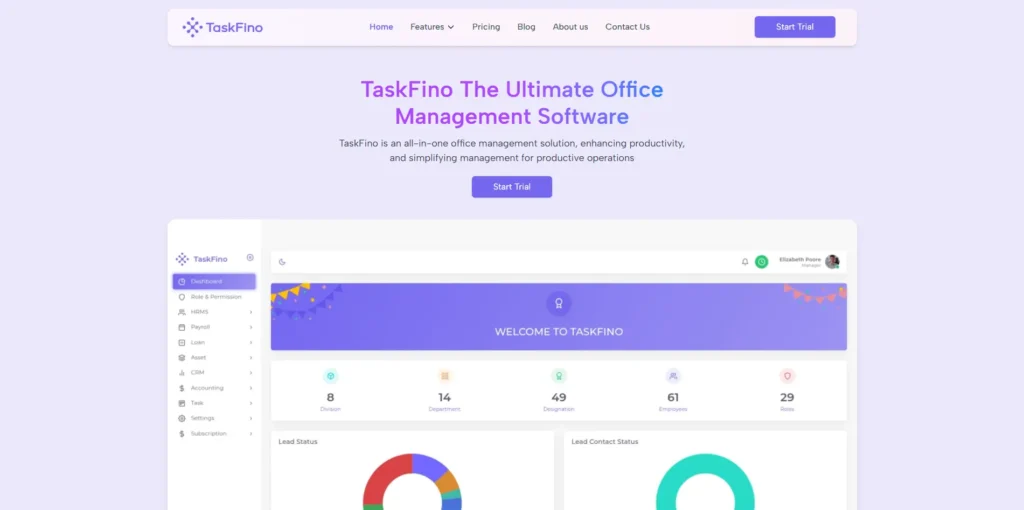
1. TaskFino (Best for SMBs Replacing Multiple Tools at Once)
TaskFino takes a fundamentally different approach from every other tool on this list. Where most alternatives focus on desk booking with a few HR add-ons, TaskFino is a full office management platform that bundles HRMS, payroll, attendance tracking, CRM, accounting, and task management into one system.
If your team is paying for three or four separate tools alongside a desk-booking platform, TaskFino lets you consolidate everything under one roof.
The platform ships with 8+ modules, 50+ sub-modules, and 110+ functionalities, covering everything from employee onboarding and leave policies to loan management and asset tracking.
Its attendance module handles remote check-ins, overtime, and year-end processing automatically, which removes the manual reconciliation that plagues teams using disconnected tools.
The built-in payroll engine calculates salaries, deductions, provident fund contributions, and festival bonuses without needing a separate payroll app.
Pricing runs on annual plans by team size:
- Startup — $199/year, up to 10 users
- Growth — $399/year, up to 25 users
- Scale — $699/year, up to 50 users
- Enterprise — $1,299/year, up to 100 users
All plans include 24/7 support and custom domain hosting.
Best Practice: If you are switching from Deskbird specifically because of rising per-user costs across multiple tools, run a quick audit of every SaaS subscription your team currently pays for.
TaskFino’s consolidated model often replaces three to five tools in one move.
Best for: Small to mid-sized businesses that want to retire their patchwork of HR, payroll, CRM, and operations tools and manage everything from a single dashboard.
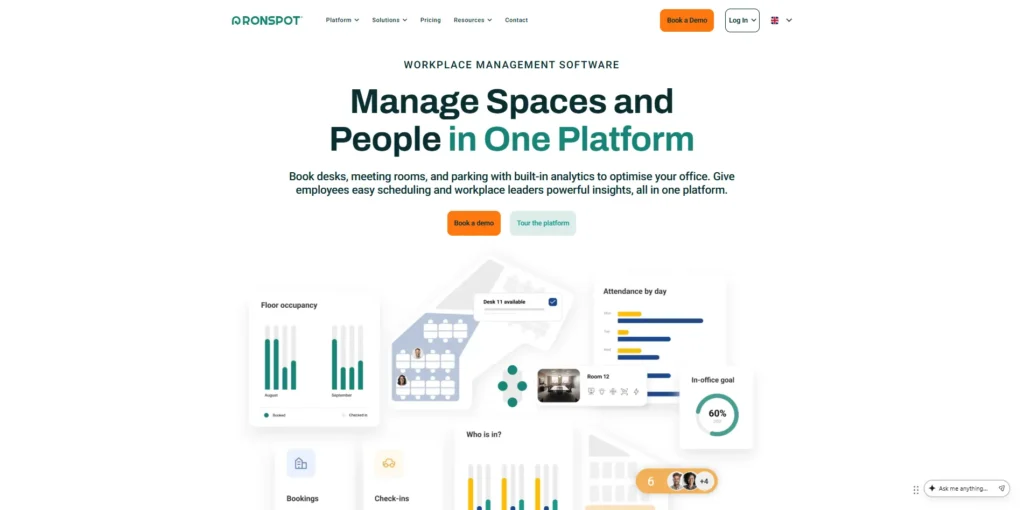
2. Ronspot: Stop Guessing Who’s Actually in the Office
Most booking platforms tell you who is planning to come in. Ronspot tells you who actually showed up. That’s a meaningful difference when you’re justifying a lease renewal to a CFO.
Ronspot connects with access control systems, parking barriers, occupancy sensors, and Wi-Fi networks. Employees walk in. The data updates automatically. No manual check-in required.
What makes it stand out:
- Hardware-backed auto check-in via access control, RFID barriers, sensors, and Wi-Fi
- Desks, rooms, and parking managed in one platform – no fragmented data
- Space-based pricing at €4/space keeps costs flat as headcount grows (unlike per-user pricing that jumps 60% when you scale from 500 to 800 employees)
- ISO 27001 certified and EU-hosted for regulated industries
Pro Tip: If you’re making any real-estate decisions, renewals, consolidations, or expansions, you need verified attendance data, not booking data. These are not the same thing.
Best for: Large enterprises and multi-site offices where occupancy accuracy drives real financial decisions.
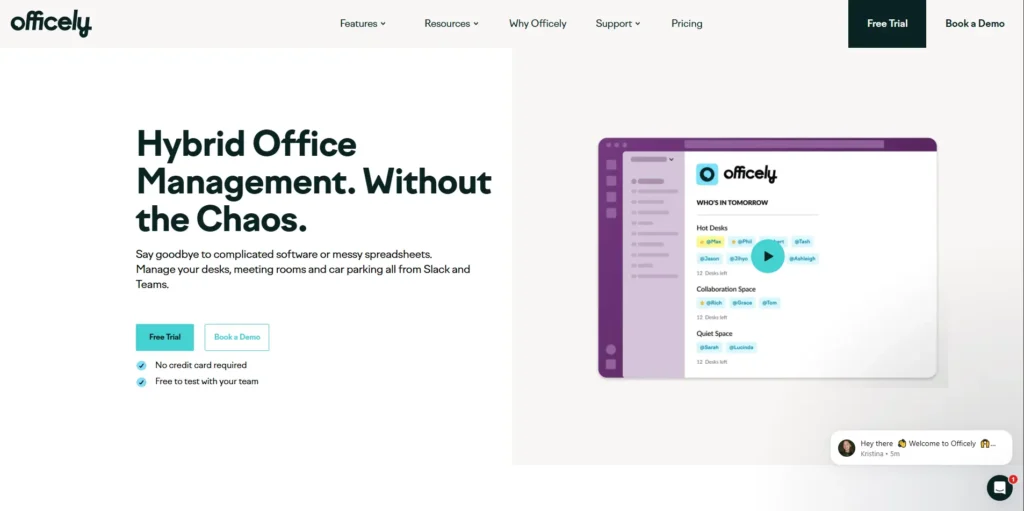
3. Officely: The Desk Booking Tool That Feels Like Nothing New
Officely wins on adoption, and adoption is everything.
It lives entirely inside Slack and Microsoft Teams, which means your team never opens a new app, creates a new login, or changes their workflow. Setup takes about five minutes.
Plans start at $2.50/user/month with month-to-month contracts. There’s also a free tier for up to five users, making it a strong option for early-stage startups.
What makes it stand out:
- Desk booking, room scheduling, and “who’s in today” visibility all happen inside Slack or Teams
- No context switching, no new tools to learn
- Free tier available for teams under five people
Limitation to know: The Teams version is more limited than the Slack integration.
Features like office chat and check-ins are better supported on Slack. Officely also lacks visitor management and deep analytics, so it’s less suited for offices that need enterprise-grade reporting.
Best for: Small and mid-sized teams that want maximum adoption and zero friction.
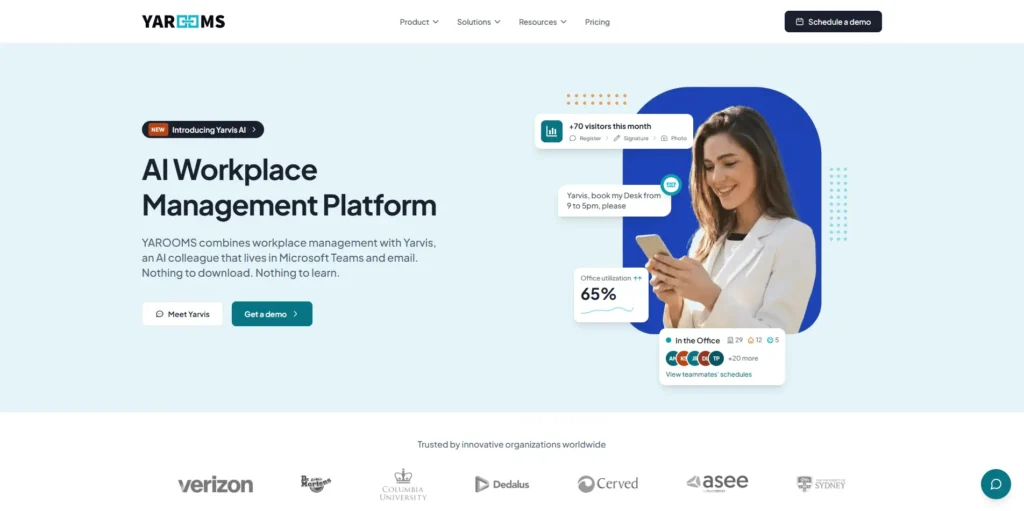
4. YAROOMS: One Platform That Handles Everything
YAROOMS is the closest thing to a complete workplace OS on this list.
It combines desk booking, room scheduling, parking, visitor management, digital signage, and analytics. Tying it all together is Yarvis, an AI assistant that works inside Microsoft Teams and email threads.
Users can chat with Yarvis to book a desk near their teammates, find an available room, or submit a facility request, without learning a new interface.
Pricing starts at $99/month with no annual commitment required.
What makes it stand out:
- Yarvis AI handles natural language booking inside Teams and email
- 3D interactive floor plans that go well beyond standard map views
- ISO 27001, ISO 27701, SOC 2 Type II, and full GDPR compliance, critical for banking, healthcare, and government
Good to Know: If your organization is in a regulated industry and needs one platform to cover every layer of workplace management, YAROOMS is built for exactly that.
Best for: Mid-to-large organizations in regulated industries that want everything in one place.
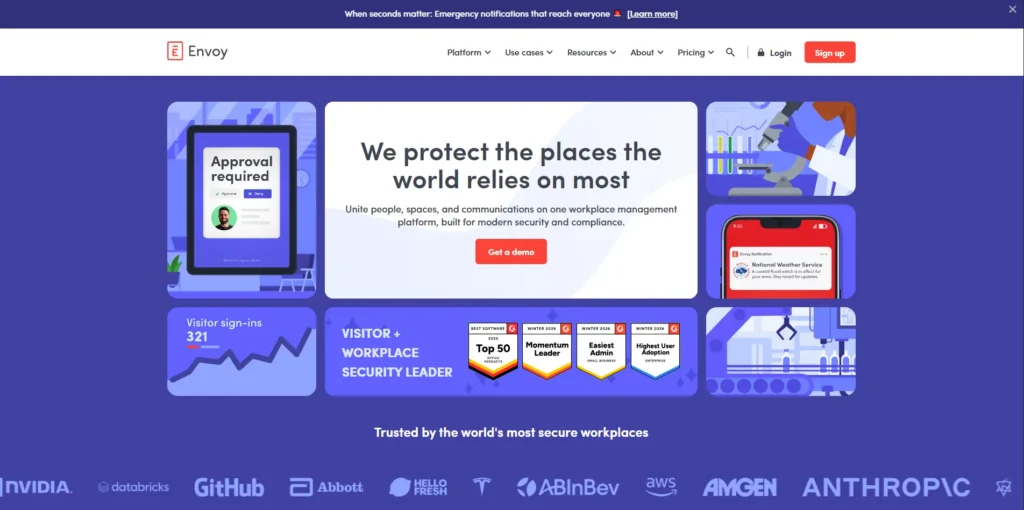
5. Envoy: Built for Offices Where Visitors Are Part of Daily Life
Envoy started as a visitor management platform and expanded from there.
That history matters because most desk booking tools treat visitor management as an add-on, something bolted on after the fact. Envoy built the front-desk experience first.
Branded check-in flows, badge printing, photo capture, watchlists, and emergency notifications are core to the product, not extras.
It also offers delivery and mailroom tracking, which almost no other platform in this category includes.
What makes it stand out:
- Pre-registration, NDAs, watchlists, and host notifications are all built in
- Delivery and mailroom tracking included
- Access control and Wi-Fi integrations for high-security environments
Limitation to know: Visitor management is a separate product priced at $109–$329 per location/month on top of the Workplace plan.
Parking management is basic, reservation-only, with no barrier integration.
Best for: Offices with high guest volumes, security-sensitive environments, or frequent client and contractor visits.
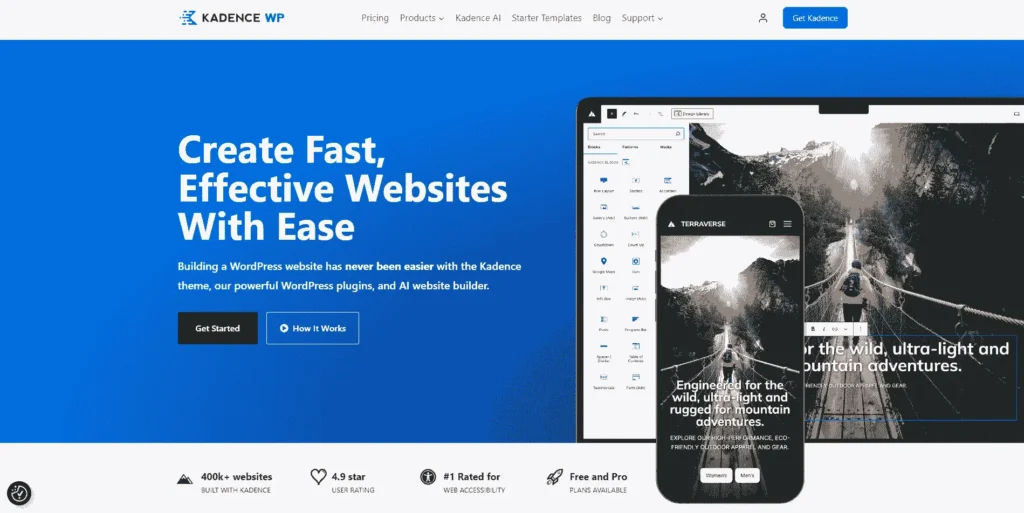
6. Kadence: Get the Right People in the Office on the Same Day
Kadence takes a different angle.
It’s less about where you sit and more about when your team comes in together. The platform’s AI engine analyzes team habits, then suggests the best office days to maximize overlap, solving the frustrating problem of commuting only to find your whole team is remote.
Check-in happens automatically when employees connect to the office Wi-Fi. No tapping, no confirming.
What makes it stand out:
- AI nudges recommend the best overlap days based on preferences and patterns
- Wi-Fi-based automatic check-in, no manual action required
- Event management with push notifications to staff
Limitation to know: Kadence uses custom, quote-based pricing (previously around $4/user/month), which makes direct budget comparisons harder.
Parking management is basic with no hardware integration.
Best for: Distributed or async-first teams moving into a structured hybrid model where coordination is the core challenge.
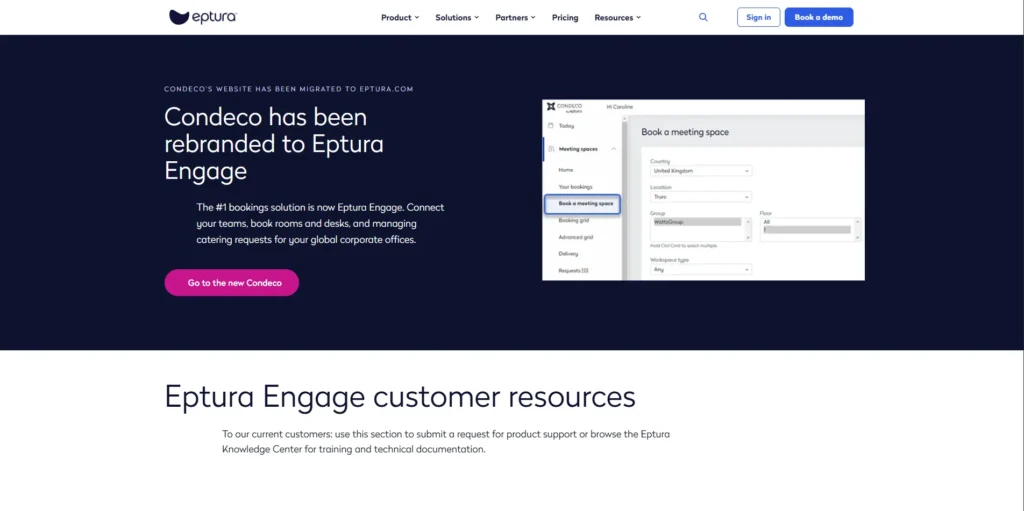
7. Condeco: The Enterprise Choice for Deep Microsoft 365 Integration
Condeco, now part of the Eptura portfolio, is the enterprise workhorse here.
It has deep roots in the Microsoft ecosystem and is built for large organizations with complex room booking workflows, multi-location estates, and years of legacy IT infrastructure.
Its Microsoft Outlook and Exchange integration is among the deepest available. Room bookings sync directly with Outlook calendars, which matters enormously for Microsoft-centric organizations.
What makes it stand out:
- Direct sync with Outlook calendars and Exchange
- Automated check-in via access control and occupancy sensors
- Integration with the broader Eptura platform for real-estate planning, move management, and facilities management
Limitation to know: Condeco’s interface feels dated compared to newer platforms. Pricing is custom-only with annual commitments for 250+ employee organizations.
There is no public API for custom integrations.
Best for: Large enterprises already deeply invested in Microsoft 365/Exchange, or organizations in the Eptura ecosystem.
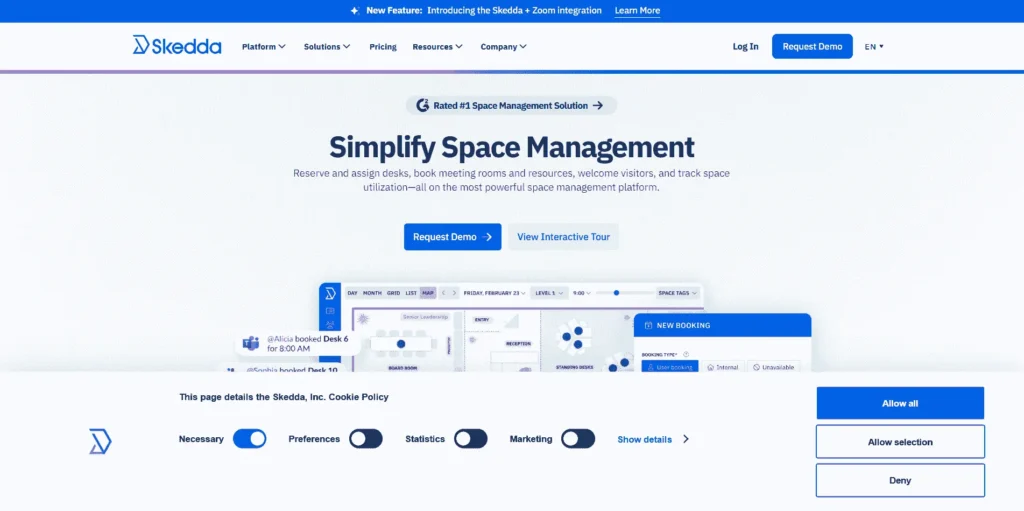
8. Skedda: The Booking Platform Built for Organizations With Strict Rules
Skedda was built to manage complex, multi-purpose booking scenarios, originally for universities, sports centers, and coworking facilities.
That background gives it a rules engine that goes well beyond what most workplace platforms offer.
Admins can define exactly who books what, when, for how long, in what order, and under what conditions. December 2025 introduced custom admin role functionality, giving even more granular permission control.
What makes it stand out:
- Set maximum booking durations, advanced notice requirements, role-based access, time-block restrictions, and custom conditions per space type
- Per-space pricing starts at $99/month for up to 15 spaces — costs tied to physical resources, not headcount
- Built for strict booking governance across diverse space types
Limitation to know: Per-space pricing can climb fast. Every bookable item, desk, room, locker, parking spot, counts toward plan limits.
Skedda also lacks hardware integrations beyond Wi-Fi and isn’t optimized for standard hybrid office UX.
Best for: Universities, government bodies, law firms, research labs, and regulated enterprises where booking policy is non-negotiable.
How to Pick the Right One Without Wasting Weeks on Demos
The fastest way to choose is to identify your single biggest pain point. Everything else follows from that.
- Real-estate decisions that need accurate occupancy data — Ronspot
- Maximum adoption inside Slack or Teams — Officely
- All-in-one platform with an AI assistant — YAROOMS
- High guest volume and front-desk operations — Envoy
- Getting teams to overlap on the same day — Kadence
- Complex Microsoft 365/Exchange environment — Condeco
- Strict, policy-driven booking governance — Skedda
Beyond that, match the pricing model to your growth trajectory. Per-user pricing works well for small, stable teams. Per-space pricing scales more efficiently as headcount grows.
And if deep analytics or business process improvement is on your roadmap, prioritize platforms with real reporting, not just booking logs.
If you’re also evaluating broader Airtable alternatives or Basecamp alternatives to consolidate your stack further, the same framework applies: start with the pain point, then match the tool.
The Bottom Line
There’s no single best alternative to Deskbird in 2026.
There’s only the right tool for your specific problem. A startup on Slack has no business evaluating Condeco. A regulated enterprise making real estate decisions has no business relying on booking-only data.
Know your problem. Pick the tool that solves it. Start there, and the decision almost makes itself.
Discover More Alternatives for a clear Vision
Questions You’ll Probably Ask Before Switching
What is the main difference between Deskbird and its alternatives?
Most alternatives solve a specific gap Deskbird leaves open, whether that’s hardware-verified attendance, stricter booking rules, deeper Microsoft integration, or better visitor management.
Why is space-based pricing cheaper than per-user pricing for large teams?
Space-based pricing stays flat as headcount grows, while per-user pricing compounds with every new hire and can jump significantly as your team scales.
How do hardware integrations like sensors and WiFi improve workplace data accuracy?
They verify who physically showed up rather than who made a booking, giving you real attendance data instead of reservation data.
Can these tools manage office parking alongside desk booking?
Yes. Ronspot, YAROOMS, and Kadence all include parking management, though only Ronspot supports hardware barrier integrations.
Which Deskbird alternative works best inside Microsoft Teams or Slack?
Officely is the most native experience for both, while YAROOMS offers its Yarvis AI assistant inside Teams specifically.
What is ghost booking, and how do I prevent it?
A ghost booking is a reserved desk or room that goes unused with no cancellation. Tools with auto check-in via WiFi or access control eliminate this automatically.
Do any of these alternatives offer a free version for small teams?
Officely offers a free tier for up to five users with full features included.